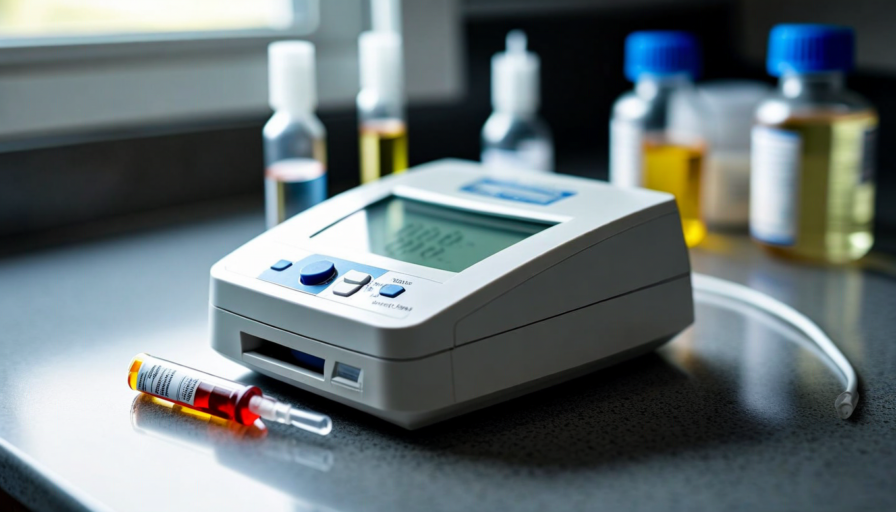
Point-of-care blood analyzers have become standard equipment in companion animal practices of nearly every size. The promise is straightforward: rather than sending a sample to a reference laboratory and waiting 12 to 24 hours, a clinician can have a chemistry panel or complete blood count result within 10 to 15 minutes, while the patient is still in the exam room. That speed has real clinical value. It also has real limitations, and practices that understand both will make better decisions about when to use in-house analyzers and when to defer to reference laboratory testing.
This article covers the analytical accuracy gap between point-of-care and reference laboratory methods, the clinical scenarios where that gap matters, the scenarios where it does not, and how multi-marker diagnostic platforms relate to both testing modalities.
What Point-of-Care Analyzers Actually Are
The dominant veterinary point-of-care chemistry analyzers — platforms from IDEXX, Heska, Abaxis (now Zoetis), and a smaller number of competitors — use one of two primary analytical approaches: dry-chemistry slide technology or microfluidic cartridge systems. Both measure analyte concentrations by detecting optical or electrochemical signals from reactions between the sample and reagents embedded in the test cartridge or slide.
Reference laboratories use wet-chemistry analyzers: large-format automated platforms (Roche Cobas, Siemens Atellica, Abbott Architect) that process samples in liquid reagent systems. These platforms have larger sample volumes, more rigorous quality control cycles, and consistent temperature control in dedicated laboratory environments. They also have a larger installed base of method-validation studies and decades of manufacturer investment in reducing analytical imprecision.
The practical result: reference laboratory chemistry panels have coefficient of variation (CV) values — a measure of run-to-run consistency — in the 1.5 to 3.0% range for most analytes. Point-of-care analyzers run 3 to 7% CV under optimal conditions, higher in practices that do not strictly follow temperature storage requirements for cartridges or that run samples outside the recommended hematocrit range.
Where the Accuracy Gap Is Clinically Relevant
Monitoring patients near decision thresholds
The accuracy gap matters most when a clinical decision hinges on a value being above or below a specific threshold, and the patient's true value is near that threshold. Consider a dog with established chronic kidney disease being monitored monthly. If SDMA is 15 µg/dL on the reference laboratory result, a point-of-care result of 13 or 17 µg/dL is analytically plausible given measurement imprecision. If the clinical team is tracking whether SDMA is trending above 18 µg/dL — a threshold that might trigger a treatment escalation decision — a 2 to 4 µg/dL uncertainty range creates real clinical noise.
The same logic applies to potassium in cats with chronic kidney disease, where the clinical difference between 3.4 and 3.8 mEq/L can change a supplementation decision. Or to ALT in a dog on a potentially hepatotoxic medication, where a reading of 3x upper limit of normal versus 4x changes whether you continue or pause the drug.
Measuring analytes with inherent reference range variability
Some analytes have reference ranges that were established with reference laboratory methods, and the analytical imprecision of point-of-care platforms is large enough relative to the range itself that the result should be interpreted with caution. SDMA is the clearest example: the reference range upper limit is 14 µg/dL for dogs and 16 µg/dL for cats in IDEXX's own reference data. A point-of-care platform with 5% CV and a measurability range of ±2 µg/dL at that concentration means that a result of 13 µg/dL should be read as "probably within the reference range, but a confirmatory reference laboratory sample is appropriate before acting on it."
Lipemic or hemolyzed samples
Point-of-care analyzers have less robust interference-handling than large reference laboratory platforms. Lipemia, hemolysis, and icterus cause measurable interference with triglycerides, glucose, and bilirubin measurements, respectively. Reference laboratories report interference indices on every sample and can flag results where interference exceeds defined thresholds. Most point-of-care analyzers either do not measure interference indices at all or report them with less precision than reference laboratory systems. A fasted sample in a stable, well-hydrated patient is unlikely to have significant interference; an emergency case with hemolysis from a traumatic venipuncture or a dog in diabetic ketoacidosis with lipemia may need reference laboratory confirmation.
Where Point-of-Care Performs Well
Confirming clinically obvious diagnoses
A cat presenting with acute collapse, bradycardia, and ECG changes consistent with hyperkalemia does not need reference laboratory confirmation before starting treatment for hypoadrenocorticism. A glucose of 42 mg/dL on a point-of-care analyzer in a dog with acute weakness and a history of insulinoma is actionable immediately. A BUN of 180 mg/dL and creatinine of 12 mg/dL in a dog with vomiting, diarrhea, and uremic breath is not going to be normal on a reference laboratory sample. When the clinical picture is unambiguous and the point-of-care result is far from normal, the analytical precision of the measurement is usually not the limiting factor in the clinical decision.
Pre-anesthetic screening in healthy patients
A 3-year-old dog with no clinical abnormalities presenting for routine ovariohysterectomy needs pre-anesthetic bloodwork primarily to confirm that there is no occult hepatic or renal impairment that would change anesthetic protocol. A borderline ALT of 68 U/L (reference range up to 60 U/L) on a point-of-care analyzer in this context is worth noting in the record and perhaps rechecking in 3 to 6 months, but it is not going to change the anesthetic plan. The point-of-care result does its job: it confirms no gross abnormality.
Rapid triage decisions
Emergency medicine runs on time. A point-of-care lactate measurement in a dog with suspected GDV changes how quickly the team moves to stabilization and surgery. A glucose in a seizing cat identifies hypoglycemia as a treatable cause in minutes rather than hours. A PCV and total protein on a collapsed dog differentiates hemorrhagic from non-hemorrhagic shock and guides fluid strategy. None of these applications require reference laboratory precision because the clinical decisions they drive are binary and time-sensitive.
Practical Protocol Decisions
When to confirm with reference laboratory testing
A rational approach reserves reference laboratory confirmation for cases where: (1) the point-of-care result is near a decision threshold and the clinical consequence of acting on an imprecise result is significant; (2) the sample has visible hemolysis, lipemia, or icterus; (3) the result is unexpectedly abnormal in a patient with no supporting clinical signs; or (4) the decision being made involves starting a long-term medication with significant cost or risk, such as immunosuppressive doses of glucocorticoids, antifungal therapy, or a chemotherapy protocol.
Reference laboratory for multi-marker panels
Multi-marker diagnostic panels that integrate 8 to 12 analytes into a composite risk score depend on each individual analyte being measured with sufficient precision for the mathematical integration to produce meaningful output. A gradient-boosted model trained on reference laboratory measurements should not be applied to point-of-care measurements without validation that the analytical imprecision of the point-of-care platform does not substantially degrade model output. This is a current limitation of AI-based veterinary diagnostic platforms, including our own: our models were trained and validated on reference laboratory data. We explicitly recommend reference laboratory samples for our multi-marker panels for this reason.
The Case for Hybrid Workflows
The frame of "point-of-care vs. reference laboratory" is a false choice in most practices. The useful question is: what does this patient need, and what does the result need to do? An emergency patient needs immediate results; use the in-house analyzer. A stable patient presenting for a chronic kidney disease recheck where the result will drive a treatment change needs reference laboratory precision; send the sample. A pre-anesthetic screen in a healthy young adult can use the in-house analyzer with a low threshold for reference laboratory confirmation if any value is borderline.
Practices that establish explicit protocols for which case types go to reference laboratory and which use in-house analyzers — rather than defaulting to in-house because it is faster — tend to generate more internally consistent patient data over time. That consistency matters when you are tracking trends. A dog monitored for early CKD for 3 years on consistent reference laboratory methodology produces a trend dataset that is interpretable. The same dog monitored alternately on in-house and reference laboratory platforms, with different absolute values from each, produces a noisier picture.
A Note on Analyte-Specific Limitations
Not all analytes perform equally on point-of-care platforms. Glucose and PCV are highly reliable across all analyzer types. Creatinine, BUN, and total protein perform well within reference range. Electrolytes — sodium, potassium, chloride — generally perform acceptably but potassium in particular is sensitive to hemolysis-induced interference. Thyroid function (T4, fT4) is not available on most in-house chemistry analyzers and requires reference laboratory immunoassay in any case. SDMA, cystatin-C, NT-proBNP, and most specialized markers are also reference laboratory only. The practical implication: for any panel that includes specialized markers, the sample is going to the reference laboratory regardless, and the clinician can simply include the standard chemistry panel in the same send rather than running a parallel in-house panel.
Summary
Point-of-care blood analyzers are clinically valuable tools with a defined scope of appropriate use. They are not a lower-quality substitute for reference laboratory testing; they are a different tool suited to different clinical situations. Speed has genuine value when time-sensitive decisions depend on it. Precision matters more than speed when the decision involves monitoring a patient near a threshold over time, interpreting a multi-marker panel, or making a treatment commitment based on a borderline result.
Understanding this distinction — and building practice protocols that reflect it — produces better patient outcomes and better data than treating every blood sample the same way regardless of clinical context.